| |
| Toxin Name |
ω-agatoxin-Aa3a |
| Source Species |
Agelenopsis aperta (Western grass spider) |
| Toxin Group |
Agatoxin |
| Description |
ω-AGTX-Aa3a is the prototypic member of a family of insecticidal and vertebrate-active toxins from Agelenopsis aperta that block a wide range of voltage-gated calcium (Cav) channels. The toxin blocks calcium channels in insect central neurons but not at peripheral neuromuscular junctions. In vertebrates, it is broadly activity against all high-threshold Cav1 channels and Cav2 channels, with radioligand binding studies indicating that the toxin defines a common high-affinity binding site (Kd = 5-10 pM) on vertebrate Cav2.1, 2.2 and 2.3 channels. However, the toxin is ineffective at blocking Cav3 (T-type) channels and it has no effect on voltage-dependent sodium and potassium currents in frog sympathetic or rat dorsal root ganglion neurons.
Curiously, the toxin completely blocks L-type currents in myocardial cells but the block of Cav2 channels is only partial even at saturating concentrations of toxin. It has been suggested that the toxin occludes inward current by acting as a partial plug or "leaky lid" in the outer region of the channel vestibule. The binding sites for ω-AGTX-Aa3a and ω-AGTX-Aa4a on Cav2.1 (P/Q-type) channels are distinct and non-overlapping.
[125I]-labelled toxin binds to neuron-rich layers in rat brain (such as the granule cell layer of the cerebellum and the pyramidal and granule cell layers of the hippocampal formation) and to areas rich in synaptic terminals (such as the substantia nigra reticulata and the molecular layers of the cerebellum and dentate gyrus of the hippocampal formation). Intracranial injection in mice leads to lethal convulsions.
The toxin is present in A. aperta venom at low concentration (20 μM). |
| Discovered |
1991 |
|

|
| This toxin last updated on Aug 20, 2010 |
|
| Current Taxonomy |
Historic Taxonomy |
| Kingdom |
Animalia |
| Phylum |
Arthropoda |
| Class |
Arachnida |
| Order |
Araneae |
| Infra-order |
Araneomorphae |
| Family |
Agelenidae |
| Genus |
Agelenopsis |
| Species |
aperta |
|
| Agelena aperta |
| Agelenopsis aperta |
| Agelenopsis aperta guttata |
| Agelenopsis gertschi |
|
|
| Molecular Target |
ED50 |
IC50 |
Kd |
Pharmacophore |
Comment |
| Calcium channel, voltage-gated (vertebrate): CaV2.2 |
|
1.4
nM
|
|
|
Block of omega-conotoxin GIVA-sensitive Cav2.2 currents in frog sympathetic neurons |
| Calcium channel, voltage-gated (invertebrate) |
|
10.0
nM
|
|
|
Block of Cav currents in locust thoracic ganglion neurons |
| Calcium channel, voltage-gated (vertebrate): CaV1, non-specific |
|
1.4
nM
|
|
|
Block of dihydropyridine-sensitive L-type currents in rat dorsal root ganglion neurons |
|
| Original Deposition References |
Mintz I.M., Venema V.J., Adams M.E., Bean B.P.
Proc. Natl. Acad. Sci. USA 88:6628-6631 (1991)
Inhibition of N- and L-type Ca(2+) channels by the spider venom toxin omega-Aga-IIIA
|
Venema V.J., Swiderek K.M., Lee T.D., Hathaway G.M., Adams M.E.
J. Biol. Chem. 267:2610-2615 (1992)
Antagonism of synaptosomal calcium channels by subtypes of omega-agatoxins.
|
| Other References |
Bindokas V.P., Venema V.J., Adams M.E.
J. Neurophysiol. 66 :590-601 (1991)
Differential antagonism of transmitter release by subtypes of omega-agatoxins
|
Olivera B.M., Imperial J.S., Cruz L.J., Bindokas V.P., Venema V.J., Adams M.E.
Ann. NY Acad. Sci. 635:114-122 (1991)
Calcium channel-targeted polypeptide toxins
|
Pocock J.M., Venema V.J., Adams M.E.
Neurochem. Int. 20:263-70 (1992)
Omega-agatoxins differentially block calcium channels in locust, chick and rat synaptosomes
|
McIntosh J.M., Adams M.E., Olivera B.M., Filloux F.
Brain Res. 594:109-114 (1992)
Autoradiographic localization of the binding of calcium channel antagonist, [125I]omega-agatoxin IIIA, in rat brain
|
Adams M.E., Myers R.A., Imperial J.S., Olivera B.M.
Biochemistry 32:12566-12570 (1993)
Toxityping rat brain calcium channels with omega-toxins from spider and cone snail venoms
|
Ertel E.A., Warren V.A., Adams M.E., Griffin P.R., Cohen C.J., Smith M.M.
Biochemistry 33:5098-5108 (1994)
Type III omega-agatoxins: a family of probes for similar binding sites on L- and N-type calcium channels
|
Olivera B.M., Miljanich G.P., Ramachandran J., Adams M.E.
Annu. Rev. Biochem. 63:823-867 (1994)
Calcium channel diversity and neurotransmitter release: the omega-conotoxins and omega-agatoxins
|
Adams M.E., Olivera B.M.
Trends Neurosci. 17:151-155 (1994)
Neurotoxins: overview of an emerging research technology
|
Yan L., Adams M.E.
J. Biol. Chem. 275:21309-21316 (2000)
The spider toxin omega-Aga IIIA defines a high affinity site on neuronal high voltage-activated calcium channels
|
McDonough S.I., Boland L.M., Mintz I.M., Bean BP.
J. Gen. Physiol. 119:313-328 (2002)
Interactions among toxins that inhibit N-type and P-type calcium channels
|
|
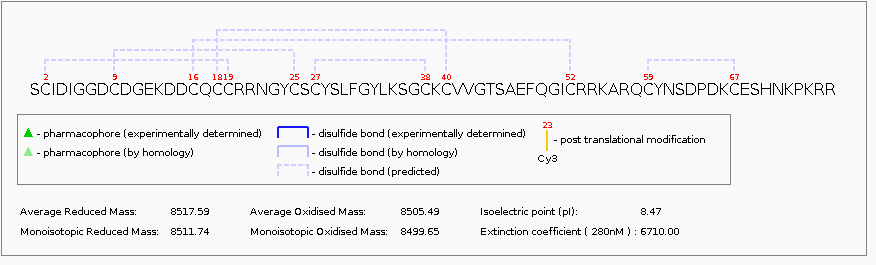
| Disulfide Bonds |
| Left Residue |
Right Residue |
Evidence |
| 2 |
19 |
Predicted |
| 9 |
25 |
Predicted |
| 16 |
52 |
Predicted |
| 18 |
40 |
Predicted |
| 27 |
38 |
Predicted |
| 59 |
67 |
Predicted |
|
|
| Peptide Sequences |
>as:ω-agatoxin-Aa3a|sp:P33034 Toxin (Omega-Aga-IIIA) from the venom of the spider Agelenopsis aperta that blocks Cav1 and Cav2 channels
SCIDIGGDCDGEKDDCQCCRRNGYCSCYSLFGYLKSGCKCVVGTSAEFQGICRRKARQCY
NSDPDKCESHNKPKRR |
Full BLAST |
BLAST mature toxin only
|
|
| Synonym |
Type |
| ω-agatoxin-Aa3a |
Recommended full name |
| ω-AGTX-Aa3a |
Recommended abbreviation |
| ω-agatoxin IIIA |
Synonym |
| ω-Aga-IIIA |
Synonym (abbreviation) |
|
|
|





