| |
| Toxin Name |
ω-agatoxin-Aa4a |
| Source Species |
Agelenopsis aperta (Western grass spider) |
| Toxin Group |
Agatoxin |
| Description |
ω-AGTX-Aa4a has become the defining pharmacology for vertebrate voltage-gated P/Q-type (Cav2.1) channels. However, it is less well known that ω-AGTX-Aa4a blocks Cav currents in at least some insect neurons with equal or higher potency than its effect on vertebrate Cav currents and the toxin is therefore assumed to have insecticidal activity. This is perhaps not surprising since the toxin is derived from spider venom and the physiologically relevant target of the toxin is almost certainly insect rather than vertebrate Cav channels. ω-Aga-IVA has no effect on presynaptic Cav channels at the insect neuromuscular junction but it is a potent blocker of Cav channels in both insect and vertebrate central neurons.
The binding site for ω-AGTX-Aa4a has been localized in part to the extracellular S3-S4 loop in repeat IV of the α1 subunit of mammalian Cav2.1 channels, which is proximal to the S4 sensor domain. A Glu1658 to Lys mutation in this loop causes a 200-fold reduction in the binding affinity for ω-AGTX-Aa4a, whereas a two-residue insertion in the S3-S4 loop of an alternative spliced form of the rat Cav2.1 channel resulted in an 11-fold reduction in ω-AGTX-Aa4a affinity. The inferred binding site is consistent with the primary effect of the toxin, which is not to block the channel pore, but rather to shift the threshold of channel activation to more depolarized potentials and thus decrease the probability of channel opening during excitation.
The 3D solution structure of ω-AGTX-Aa4a comprises a short disordered N-terminal region (residues 1-3), a central disulfide-rich core containing a three-stranded β-sheet (residues 4-38), and a highly disordered C-terminal region comprising residues 39-48. The disordered C-terminal "tail" is essential for activity. It has been suggested that the role of the "tail" might be to simply anchor the toxins to the cell membrane via interaction with either the lipid bilayer or transmembrane regions of the Cav channel.
ω-AGTX-Aa4a is present in venom at a concentration of 0.1 mM.
|
| Discovered |
1991 |
|

|
| This toxin last updated on Aug 20, 2010 |
|
| Current Taxonomy |
Historic Taxonomy |
| Kingdom |
Animalia |
| Phylum |
Arthropoda |
| Class |
Arachnida |
| Order |
Araneae |
| Infra-order |
Araneomorphae |
| Family |
Agelenidae |
| Genus |
Agelenopsis |
| Species |
aperta |
|
| Agelena aperta |
| Agelenopsis aperta |
| Agelenopsis aperta guttata |
| Agelenopsis gertschi |
|
|
| Molecular Target |
ED50 |
IC50 |
Kd |
Pharmacophore |
Comment |
| Calcium channel, voltage-gated (vertebrate): CaV2.1 |
|
|
2.0
nM
|
|
Block of Cav2.1 (P-type) currents in rat Purkinje neurons |
| Calcium channel, voltage-gated (invertebrate): CaV2 |
|
10.0
nM
|
|
|
Block of mid-voltage-activated Cav currents in bee brain neurons. |
|
| Original Deposition References |
Mintz I.M., Venema V.J., Swiderek K.M., Lee T.D., Bean B.P., Adams M.E.
Nature 355:827-829 (1992)
P-type calcium channels blocked by the spider toxin omega-Aga-IVA.
|
| Other References |
Wicher D., Penzlin H.
Receptors & Channels 5:355-366 (1998)
ω-Toxins affect Na+ currents in neurosecretory insect neurons
|
Olivera B.M., Imperial J.S., Cruz L.J., Bindokas V.P., Venema V.J., Adams M.E.
Ann. NY Acad. Sci. 635:114-122 (1991)
Calcium channel-targeted polypeptide toxins
|
Nishio H., Kumagaye K.Y., Kubo S., Chen Y.N., Momiyama A., Takahashi T., Kimura T., Sakakibara S.
Biochem Biophys Res Commun. 196:1447-1453 (1993)
Synthesis of omega-agatoxin IVA and its related peptides
|
Reily M.D., Holub K.E., Gray W.R., Norris T.M., Adams M.E.
Nat. Struct. Biol. 1:853-856 (1994)
Structure-activity relationships for P-type calcium channel-selective omega-agatoxins.
|
Bickmeyer U., Rössler W., Wiegand H.
Neurosci. Lett. 181:113-116 (1994)
Omega AGA toxin IVA blocks high-voltage-activated calcium channel currents in cultured pars intercerebralis neurosecretory cells of adult locusta migratoria.
|
Kim J.I., Konishi S., Iwai H., Kohno T., Gouda H., Shimada I., Sato K., Arata Y.
J. Mol. Biol. 250:659-671 (1995)
Three-dimensional solution structure of the calcium channel antagonist omega-agatoxin IVA: consensus molecular folding of calcium channel blockers.
|
McDonough S.I., Mintz I.M., Bean B.P.
Biophys. J. 72:2117-228 (1997)
Alteration of P-type calcium channel gating by the spider toxin omega-Aga-IVA.
|
Wicher D., Penzlin H.
J. Neurophysiol. 77:186-199 (1997)
Ca2+ currents in central insect neurons: electrophysiological andpharmacological properties.
|
Winterfield J.R., Swartz K.J.
J. Gen. Physiol. 116:637-344 (2000)
A hot spot for the interaction of gating modifier toxins with voltage-dependention channels
|
Wang X.H., Connor M., Wilson D., Wilson H.I., Nicholson G.M., Smith R., Shaw D., Mackay J.P., Alewood P.F., Christie M.J., King G.F.
J. Biol. Chem. 276:40306-40312 (2001)
Discovery and structure of a potent and highly specific blocker of insect calcium channels
|
Adams M.E.
Toxicon 43:509-25 (2004)
Agatoxins: ion channel specific toxins from the American funnel web spider, Agelenopsis aperta.
|
King G.F.
Toxicon 49:513-530 (2007)
Modulation of insect Ca(v) channels by peptidic spider toxins
|
|
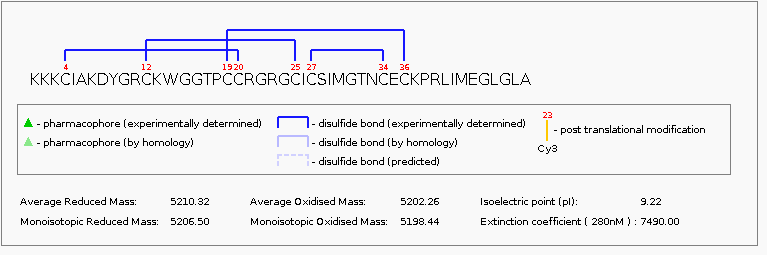
| Disulfide Bonds |
| Left Residue |
Right Residue |
Evidence |
| 4 |
20 |
Experimentally determined |
| 12 |
25 |
Experimentally determined |
| 19 |
36 |
Experimentally determined |
| 27 |
34 |
Experimentally determined |
|
|
| Peptide Sequences |
>as:ω-agatoxin-Aa4a|sp:P30288 Potent Cav2.1 blocker (ω-Aga-IVA) from the venom of the spider Agelenopis aperta
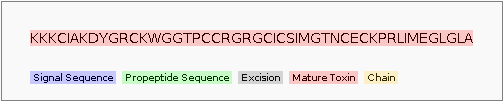
KKKCIAKDYGRCKWGGTPCCRGRGCICSIMGTNCECKPRLIMEGLGLA |
Full BLAST |
BLAST mature toxin only
|
|
| Synonym |
Type |
| ω-agatoxin-Aa4a |
Recommended full name |
| ω-AGTX-Aa4a |
Recommended abbreviation |
| ω-agatoxin IVA |
Synonym |
| ω-Aga-IVA |
Synonym |
|
|
|