|
|
 |
| |
| Toxin Name |
κ-theraphotoxin-Gr3a |
| Source Species |
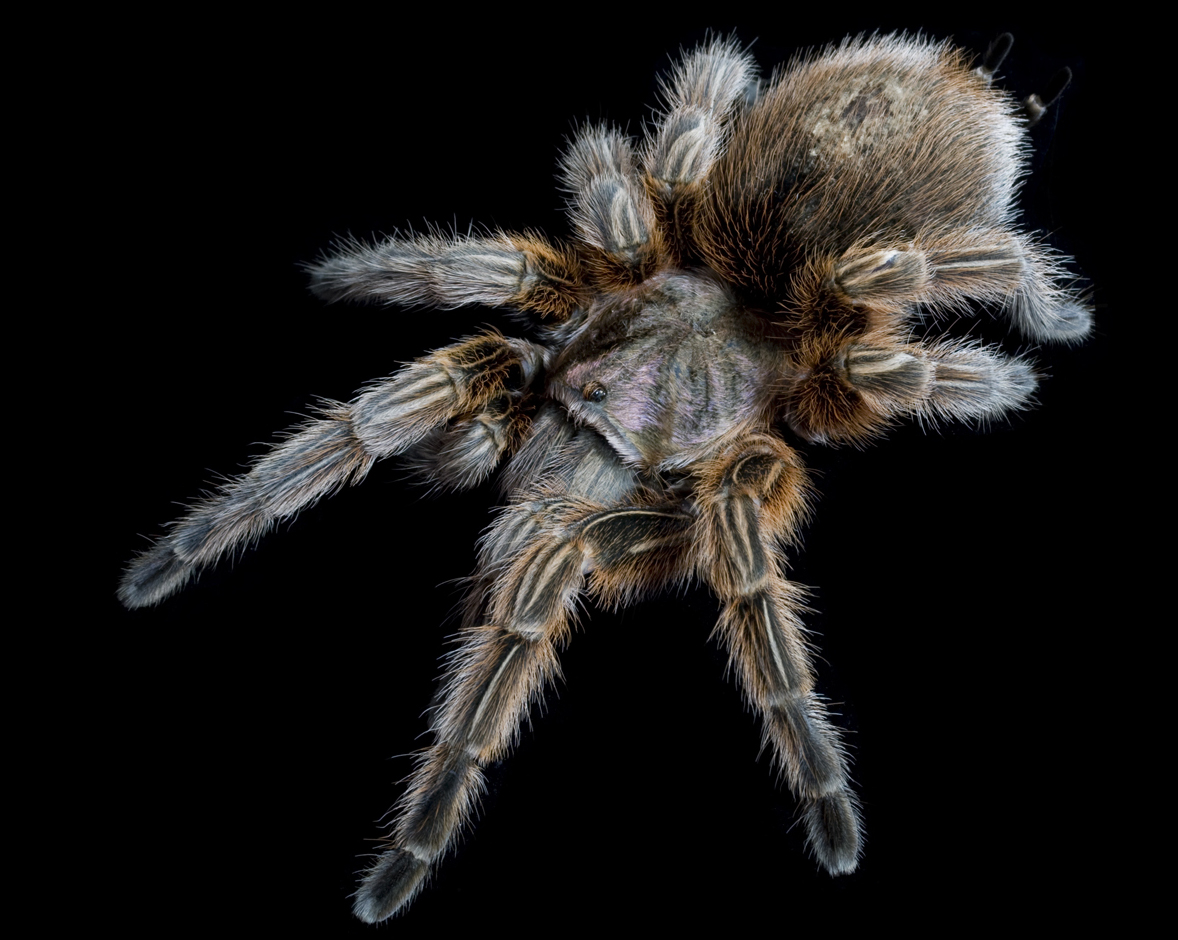
Grammostola rosea (Chilean rose tarantula) |
| Toxin Group |
Theraphotoxin |
| Description |
The toxin inhibits voltage-gated potassium channels from the archaebacterium Aeropyrum pernix by binding to the voltage sensor paddle (S3-S4 helices). The toxin exerts its effect by partitioning into the lipid membrane with the preferred location of the toxin being the membrane/water interface. |
| Discovered |
2003 |
|
Sex: female, Prosoma length: 26mm
Photo courtesy of Bastian Rast
Use of photo governed by creative
commons noncommercial license
|
| This toxin last updated on Aug 25, 2014 |
|
| Current Taxonomy |
Historic Taxonomy |
| Kingdom |
Animalia |
| Phylum |
Arthropoda |
| Class |
Arachnida |
| Order |
Araneae |
| Infra-order |
Mygalomorphae |
| Family |
Theraphosidae |
| Genus |
Grammostola |
| Species |
rosea |
|
| Citharoscelus kochii |
| Citharoscelus spatulatus |
| Eurypelma rosea |
| Eurypelma spatulatum |
| Grammostola argentinense |
| Grammostola argentinensis |
| Grammostola cala |
| Grammostola rosea |
| Grammostola spathulata |
| Grammostola spatulata |
| Grammostola spatulatus |
| Lasiodora rosea |
| Mygale rosea |
| Mygale rubiginosa |
|
|
| Molecular Target |
ED50 |
IC50 |
Kd |
Pharmacophore |
Comment |
| Potassium channel, voltage-gated (archaebacterium): KvAP (from Aeropyrum pernix) |
|
30.0
nM
|
|
|
Inhibition of KvAP expressed in Escherichia coli. 30 nM induces more than half inhibition. Kd = 303 nM in a KvAP pull down assay. |
|
| Original Deposition References |
Ruta V., Jiang Y., Lee A., Chen J., MacKinnon R.
Nature 422:180-185(2003).
Functional analysis of an archaebacterial voltage-dependent K+ channel.
|
Lee S.-Y., MacKinnon R.
Nature 430:232-235(2004).
A membrane-access mechanism of ion channel inhibition by voltage sensor toxins from spider venom.
|
Ruta V., MacKinnon R.
Biochemistry 43:10071-10079(2004).
Localization of the voltage-sensor toxin receptor on KvAP.
|
Jung H.J., Lee J.Y., Kim S.H., Eu Y.-J., Shin S.Y., Milescu M., Swartz K.J., Kim J.I.
Biochemistry 44:6015-6023(2005).
Solution structure and lipid membrane partitioning of VSTx1, an inhibitor of the KvAP potassium channel.
|
Bemporad D., Sands Z.A., Wee C.L., Grottesi A., Sansom M.S.
Biochemistry 45:11844-11855(2006).
Vstx1, a modifier of Kv channel gating, localizes to the interfacial region of lipid bilayers.
|
| Other References |
Kimura T., Kubo T.
Submitted (JAN-2005) to the EMBL/GenBank/DDBJ databases.
Grammostola spatulata venom gland cDNA.
|
|
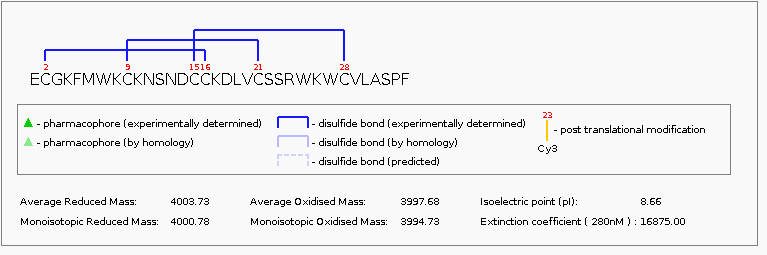
| Disulfide Bonds |
| Left Residue |
Right Residue |
Evidence |
| 2 |
16 |
Experimentally determined |
| 9 |
21 |
Experimentally determined |
| 15 |
28 |
Experimentally determined |
|
|
| Peptide Sequences |
>as:κ-theraphotoxin-Gr3a_1|sp:P60980 Toxin from venom of the spider Grammostola rosea that blocks voltage-gated potassium channels
ECGKFMWKCKNSNDCCKDLVCSSRWKWCVLASPF |
Full BLAST |
BLAST mature toxin only
|
>as:κ-theraphotoxin-Gr3a_2|sp:M5AY63 Toxin from venom of the spider Grammostola rosea that blocks voltage-gated potassium channels
MKTSVFVLVLGLVLLFAVSFATEMEESARECGKFMWKCKNSNDCCKDLVCSSRWKWCVLA
SPF |
Full BLAST |
BLAST mature toxin only
|
|
| Synonym |
Type |
| κ-theraphotoxin-Gr3a |
Recommended full name |
| κ-TRTX-Gr3a |
Recommended abbreviation |
| Voltage sensor toxin 1 |
Synonym |
| VSTX1 |
Synonym (abbreviation) |
|
|
|
|
|
 |
|
 |
|
|