| |
| Toxin Name |
M-theraphotoxin-Gr1a |
| Source Species |
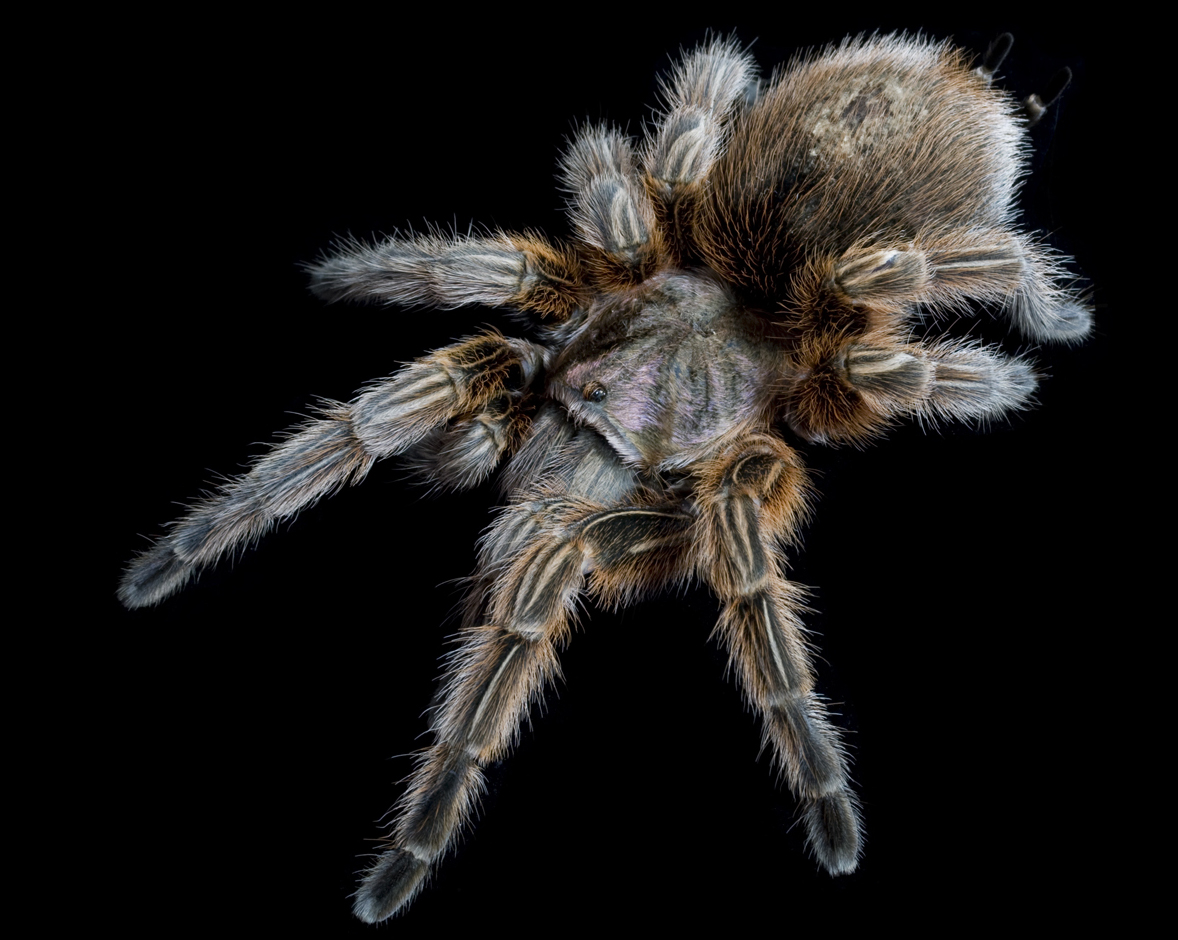
Grammostola rosea (Chilean rose tarantula) |
| Toxin Group |
Theraphotoxin |
| Description |
Toxin blocks mechanosensitive ion channels (also named strech-activated channels or SACs), without having a significant effect on whole-cell voltage-sensitive currents. The toxin acts by partitioning into the membrane and altering bilayer mechanics close to the channel. The toxin also binds to the voltage sensor of voltage-gated potassium channels from the archaebacterium Aeropyrum pernix (KvAP) without affecting channel gating. The toxin inhibits atrial fibrillation as well as the membrane motor of outer hair cells. The toxin exhibits antimicrobial activity, being more active against Gram-positive than Gram-negative bacteria. |
| Discovered |
2000 |
|
Sex: female, Prosoma length: 26mm
Photo courtesy of Bastian Rast
Use of photo governed by creative
commons noncommercial license
|
| This toxin last updated on Aug 19, 2014 |
|
| Current Taxonomy |
Historic Taxonomy |
| Kingdom |
Animalia |
| Phylum |
Arthropoda |
| Class |
Arachnida |
| Order |
Araneae |
| Infra-order |
Mygalomorphae |
| Family |
Theraphosidae |
| Genus |
Grammostola |
| Species |
rosea |
|
| Citharoscelus kochii |
| Citharoscelus spatulatus |
| Eurypelma rosea |
| Eurypelma spatulatum |
| Grammostola argentinense |
| Grammostola argentinensis |
| Grammostola cala |
| Grammostola rosea |
| Grammostola spathulata |
| Grammostola spatulata |
| Grammostola spatulatus |
| Lasiodora rosea |
| Mygale rosea |
| Mygale rubiginosa |
|
|
| Molecular Target |
ED50 |
IC50 |
Kd |
Pharmacophore |
Comment |
| Sodium channel, voltage-gated (vertebrate): NaV1.1 |
|
12100.0
nM
|
|
|
HEK293 cells expressing human channel |
| Mechanosensitive ion channel: Eukaryotic mechanosensitive channel |
|
|
630.0
nM
|
|
Toxin blocks mechanosensitive channels (= strech-activated channels) in rat astrocytes, |
| Sodium channel, voltage-gated (vertebrate): NaV1.2 |
|
8100.0
nM
|
|
|
HEK293 cells expressing human channel |
| Sodium channel, voltage-gated (vertebrate): NaV1.3 |
|
14100.0
nM
|
|
|
HEK293 cells expressing human channel |
| Sodium channel, voltage-gated (vertebrate): NaV1.4 |
|
11900.0
nM
|
|
|
HEK293 cells expressing human channel |
| Sodium channel, voltage-gated (vertebrate): NaV1.5 |
|
12200.0
nM
|
|
|
HEK293 cells expressing human channel |
| Sodium channel, voltage-gated (vertebrate): NaV1.6 |
|
8600.0
nM
|
|
|
HEK293 cells expressing human channel |
| Sodium channel, voltage-gated (vertebrate): NaV1.7 |
|
7400.0
nM
|
|
|
HEK293 cells expressing human channel |
| Taxon |
ED50 |
LD50 |
PD50 |
Qualitative Information |
| Bacillus subtilis |
|
|
|
0.5 μM = minimal inhibitory concentration
|
| Staphylococcus epidermidis |
|
|
|
4-8 μM = minimal inhibitory concentration
|
| Staphylococcus aureus |
|
|
|
2-4 μM = minimal inhibitory concentration
|
| Pseudomonas aeruginosa |
|
|
|
8-16 μM = minimal inhibitory concentration
|
| Salmonella typhimurium |
|
|
|
32.64 μM = minimal inhibitory concentration
|
| Escherichia coli |
|
|
|
8-16 μM = minimal inhibitory concentration
|
|
| Original Deposition References |
Suchyna T.M., Johnson J.H., Hamer K., Leykam J.F., Gage D.A., Clemo H.F., Baumgarten C.M., Sachs F.
J. Gen. Physiol. 115:583-598(2000).
Identification of a peptide toxin from Grammostola spatulata spider venom that blocks cation-selective stretch-activated channels.
|
Ostrow K.L., Mammoser A., Suchyna T.M., Sachs F., Oswald R.E., Kubo S., Chino N., Gottlieb P.A.
Toxicon 42:263-274(2003).
cDNA sequence and in vitro folding of GsMTx4, a specific peptide inhibitor of mechanosensitive channels.
|
| Other References |
Kimura T., Kubo T.
Submitted (JAN-2005) to the EMBL/GenBank/DDBJ databases.
Grammostola spatulata venom gland cDNA.
|
Bode F., Sachs F., Franz M.R.
Nature 409:35-36(2001).
Tarantula peptide inhibits atrial fibrillation.
|
Oswald R.E., Suchyna T.M., McFeeters R., Gottlieb P.A., Sachs F.
J. Biol. Chem. 277:34443-34450(2002).
Solution structure of peptide toxins that block mechanosensitive ion channels.
|
Ruta V., MacKinnon R.
Biochemistry 43:10071-10079(2004).
Localization of the voltage-sensor toxin receptor on KvAP.
|
Suchyna T.M., Tape S.E., Koeppe R.E. II, Andersen O.S., Sachs F., Gottlieb P.A.
Nature 430:235-240(2004).
Bilayer-dependent inhibition of mechanosensitive channels by neuroactive peptide enantiomers.
|
Fang J., Iwasa K.H.
Neurosci. Lett. 404:213-216(2006).
Effects of tarantula toxin GsMTx4 on the membrane motor of outer hair cells.
|
Jung H.J., Kim P.I., Lee S.K., Lee C.W., Eu Y.J., Lee D.G., Earm Y.E., Kim J.I.
Biochem. Biophy. Res. Comm. 340:633-638(2006)
Lipid membrane interaction and antimicrobial activity of GsMTx-4, an inhibitor of mechanosensitive channel.
|
Sachs F., Suchyna T.M., Gottlieb P.A.
Patent number WO 2006/014493 A2, 9-FEB-2006.
Mechanically activated channel blocker
|
Sachs F., Suchyna T.M., Johnson J.
Patent number US7125847, 24-OCT-2006.
Mechanically activated channel blocker
|
Bowman C.L., Gottlieb P.A., Suchyna T.M., Murphy Y.K., Sachs F.
Toxicon. 49:249-270(2007)
Mechanosensitive ion channels and the peptide inhibitor GsMTx-4: history, properties, mechanisms and pharmacology.
|
Nishizawa M., Nishizawa K.
Biophysical Journal 92:4233-4243(2007)
Molecular dynamics simulations of a stretch-activated channel inhibitor GsMTx4 with lipid membranes: two binding modes and effects of lipid structure.
|
Posokhov Y.O., Gottlieb P.A., Morales M.J., Sachs F., Ladokhin A.S.
Biophysical Journal 93:20-22(2007)
Is lipid bilayer binding a common property of inhibitor cysteine knot ion-channel blockers?
|
Sachs F., Suchyna T.M., Gottlieb P.A.
Patent number US 7259145, 21-AUG-2007.
Mechanically activated channel blocker
|
Redaelli E., Cassulini R.R., Silva D.F., Clement H., Schiavon E., Zamudio F.Z., Odell G., Arcangeli A., Clare J.J., Alagón A., de la Vega R.C., Possani L.D., Wanke E.
J. Biol. Chem. 285:4130-42(2010)
Target promiscuity and heterogeneous effects of tarantula venom peptides affecting Na+ and K+ ion channels.
|
|
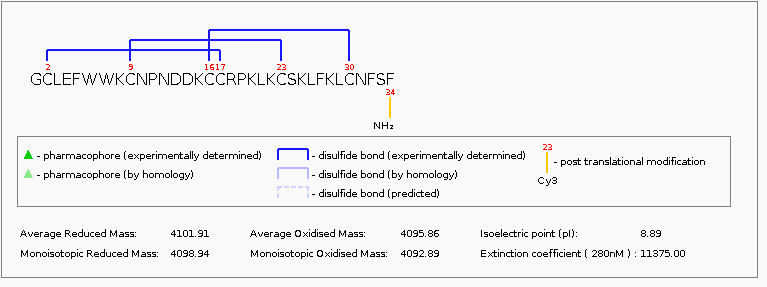
| Disulfide Bonds |
Posttranslational modifications |
| Left Residue |
Right Residue |
Evidence |
| 2 |
17 |
Experimentally determined |
| 9 |
23 |
Experimentally determined |
| 16 |
30 |
Experimentally determined |
|
| Residue Number |
Type |
Symbol |
| 34 |
C-terminal amidation |
NH₂ |
|
|
| Peptide Sequences |
>as:M-theraphotoxin-Gr1a|sp:Q7YT39 Toxin from venom of the spider Grammostola rosea that inhibits mechanosensitive channels
MKTSVVFVIAGLALLSVVCYASELKEQSSVNEVLSTIFHFEQPEERGCLEFWWKCNPNDD
KCCRPKLKCSKLFKLCNFSFGK |
Full BLAST |
BLAST mature toxin only
|
| mRNA Sequences |
>as:M-theraphotoxin-Gr1a|gb:AY316118 cDNA sequence of a toxin from the venom gland of the spider Grammostola rosea
ATGAAGACATCTGTGGTGTTCGTCATTGCAGGCTTAGCTCTGCTTTCAGTTGTCTGTTAT
GCTTCAGAACTGAAGGAGCAAAGTTCCGTCAATGAAGTGCTTTCTACAATTTTTCATTTT
GAACAACCTGAGGAAAGAGGCTGTTTGGAATTTTGGTGGAAATGCAACCCTAACGACGAC
AAATGCTGTCGTCCAAAATTGAAATGCAGTAAACTGTTCAAGTTGTGTAACTTTTCATTC
GGCAAGTAA |
Full BLAST
|
|
| Synonym |
Type |
| M-theraphotoxin-Gr1a |
Recommended full name |
| M-TRTX-Gr1a |
Recommended abbreviation |
| GsMTx4 |
Synonym |
| Grammostola mechanotoxin #4 |
Synonym |
| MTx4 |
Synonym (abbreviation) |
| GTx1-17-2 |
Synonym (abbreviation) |
| GTx1-17-1 |
Synonym (abbreviation) |
|
|
|