| |
| Toxin Name |
Sphingomyelinase D (LlSicTox1) (N-terminal fragment) |
| Source Species |
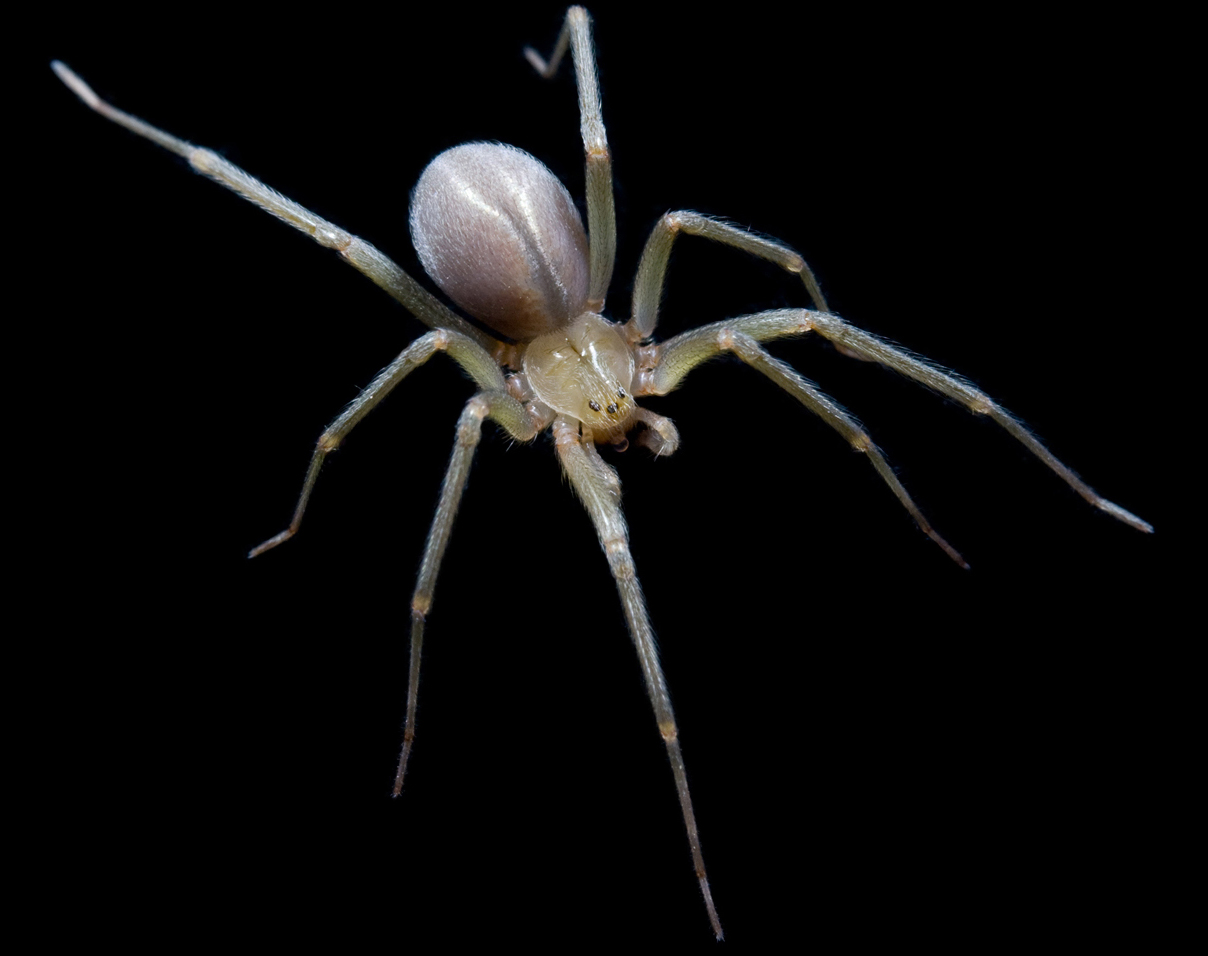
Loxosceles laeta (Chilean recluse spider) |
| Toxin Group |
Sicaritoxin |
| Description |
Sphingomyelin phosphodiesterase D (EC 3.1.4.41), also known as sphingomyelinase D (SMase D), is a highly derived member of the glycerophosphodiester phosphodiesterase (GPPD) protein family. SMase D catalyzes the hydrolysis of sphingomyelin to form ceramide 1-phosphate and choline. It is also capable of cleaving lysophosphatidylcholine to release the pleiotropic lipid mediator lysophosphatidic acid. SMase D is found only in sicariid spiders, ixodid ticks, and Corynebacteria.
The 3D structure of SMase D comprises a distorted α/β (TIM-like) barrel. A disulfide bond (typically Cys51-Cys57) that stabilizes the tip of the catalytic loop is conserved in all known sicariid SMases. A second disulfide bond is present in some but not all sicariid SMases. SMase D activity is magnesium-dependent.
SMase D is responsible for the dermonecrotic lesions and serious systemic effects (loxoscelism) that sometimes result from bites by spiders from the genera Loxosceles and Sicarius. In addition to being cytolytic, it has been proposed that SMase D may be neurotoxic to prey through indirect inhibition of ion channels. Although the North American brown recluse spider (Loxosceles reclusa) is perhaps the most well known sicariid spider, the most important species from a medical perspective are the South American spiders Loxosceles gaucho, Loxosceles intermedia (Mello-Leitão), and Loxosceles laeta, which together account for more than 3000 human envenomations per year. Several antivenoms are available but they are most effective when administered within 12 hours of envenomation.
The nomenclature used here is based on that proposed by Binford et al. (2009), which is derived from phylogenetic analyses showing that sicariid SMases can be grouped into two distinct clades, α and β. Major lineages within each clade are distinguished by Roman numerals and subgroups within each lineage are distinguished by uppercase letters. The generic name SicTox for sicariid SMases is derived from name Loxtox suggested by Kalapothakis et al. (2007) and takes account of the fact that these enzymes are found in the venom of sicariid spiders other than Loxosceles. |
| Discovered |
1995 |
|
Sex: female, Prosoma length: 2mm
Photo courtesy of Bastian Rast
Use of photo governed by creative
commons noncommercial license
|
| This toxin last updated on May 27, 2009 |
|
| Current Taxonomy |
Historic Taxonomy |
| Kingdom |
Animalia |
| Phylum |
Arthropoda |
| Class |
Arachnida |
| Order |
Araneae |
| Infra-order |
Araneomorphae |
| Family |
Sicariidae |
| Genus |
Loxosceles |
| Species |
laeta |
|
| "Loxosceles" "yura" |
| "Omosita" "bicolor" |
| "Scytodes" "laeta" |
| "Scytodes" "nigella" |
| "Scytodes" "rufipes" |
| "Loxosceles" "laeta" |
| "Loxosceles" "longipalpis" |
| "Loxosceles" "nesophila" |
| "Loxosceles" "rufipes" |
|
|
| Cytolytic |
| Dermonecrotic |
| Hemolytic |
| Molecular Target |
ED50 |
IC50 |
Kd |
Pharmacophore |
Comment |
| Sphingomyelinase D (EC 3.1.4.41) |
|
|
|
|
|
|
| Original Deposition References |
Barbaro K.C., Sousa M.V., Morhy L., Eickstedt V.R., Mota I.
J. Protein Chem. 15:337-343(1996).
Compared chemical properties of dermonecrotic and lethal toxins from spiders of the genus Loxosceles (Araneae).
|
| Other References |
van Meeteren L.A., Frederiks F., Giepmans B.N.G., Fernandes Pedrosa M.F., Billington S.J., Jost B.H., Tambourgi D.V., Moolenaar W.H.
J. Biol. Chem. 279:10833-10836(2004)
Spider and bacterial sphingomyelinases D target cellular lysophosphatidic acid receptors by hydrolyzing lysophosphatidylcholine
|
Murakami M.T., Fernandes-Pedrosa M.F., Tambourgi D.V., Arni R.K.
J. Biol. Chem. 280:13658-13664(2005)
Structural basis for metal ion coordination and the catalytic mechanism of sphingomyelinases D
|
Murakami M.T., Fernandes-Pedrosa M.F., de Andrade S.A., Gabdoulkhakov A., Betzel C., Tambourgi D.V., Arni R.K.
Biochem. Biophys. Res. Commun. 342:323-329(2006)
Structural insights into the catalytic mechanism of sphingomyelinases D and evolutionary relationship to glycerophosphodiester phosphodiesterases
|
Pauli I., Puka J., Gubert I.C., Minozzo J.C.
Toxicon 48:123-137(2006)
The efficacy of antivenom in loxoscelism treatment
|
Swanson D.L., Vetter R.S.
Clin. Dermatol. 24:213-221(2006)
Loxoscelism
|
Kalapothakis E., Chatzaki M, Gonçalves-Dornelas H., de Castro C.S., Silvestre F.G., Laborne F.V., de Moura J.F., Veiga S.S., Chávez-Olórtegu C., Granier C, Barbaro K.C.
Toxicon 50:938-946(2007)
The Loxtox protein family in Loxosceles intermedia (Mello-Leitao) venom
|
Binford G.J., Bodner M.R., Cordes M.H.J., Baldwin K.L., Rynerson M.R., Burns S.N., Zobel-Thropp P.A.
Mol. Biol. Evol. 26:547-566(2009)
Molecular evolution, functional variation, and proposed nomenclature of the gene family that includes sphingomyelinase D in sicariid spiders
|
|
| Peptide Sequences |
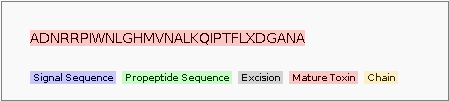
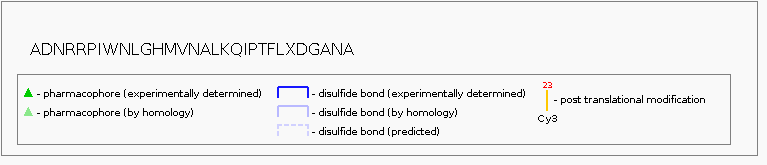
>as:SphingomyelinaseD(LlSicTox1)|sp:P0C2L1 N-terminal fragment of sphingomyelinase D (EC 3.1.4.41; LlSicTox1) from the spider Loxosceles laeta
ADNRRPIWNLGHMVNALKQIPTFLXDGANA |
Full BLAST |
BLAST mature toxin only
|
|
| Synonym |
Type |
| Sphingomyelinase D (LlSicTox1 |
Recommended full name |
| SMase D (LlSicTox1 |
Recommended abbreviation |
| Sphingomyelin phosphodiesterase D |
Synonym |
| SMase D |
Synonym |
| 32 kDa dermonecrotic toxin |
Synonym |
|
|
|