| |
| Toxin Name |
κ-theraphotoxin-Gr1a |
| Source Species |
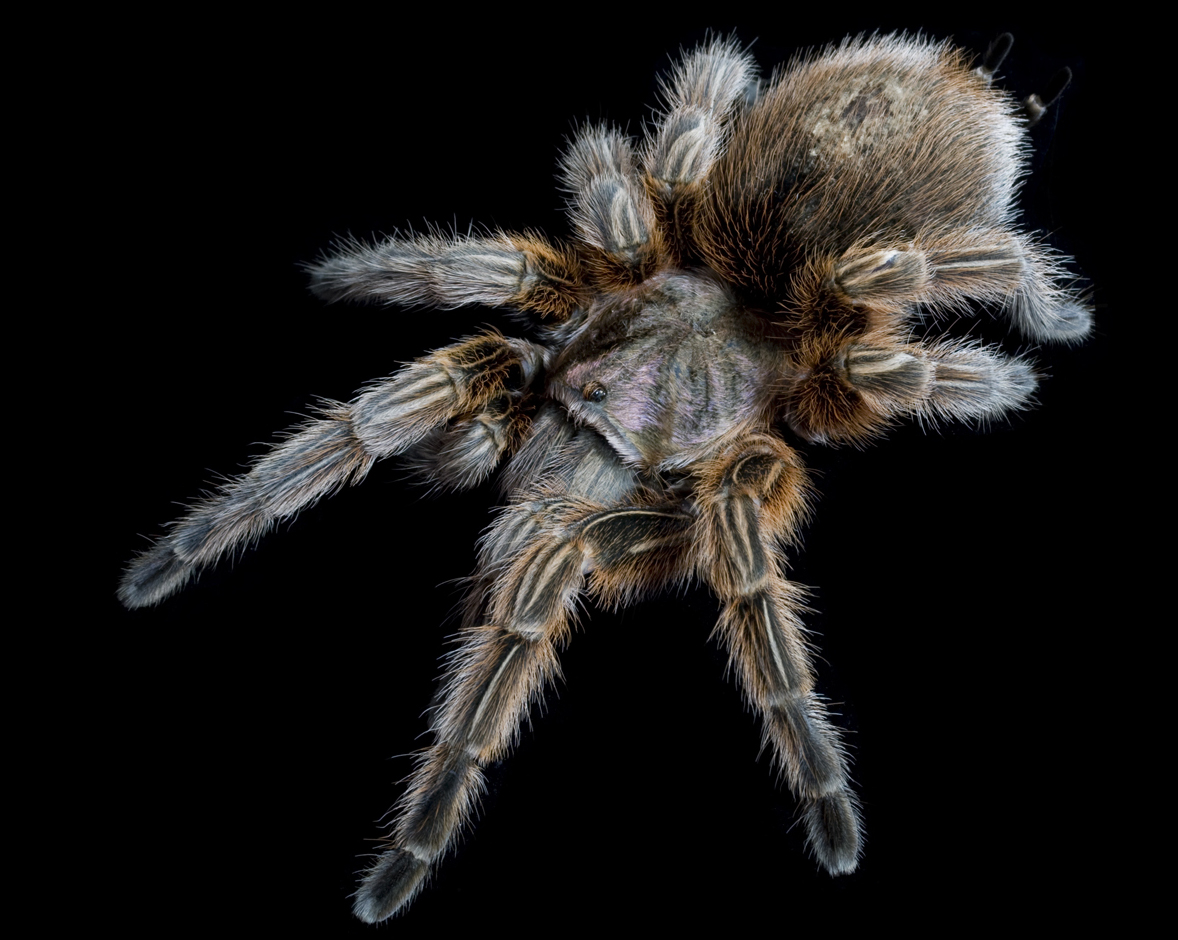
Grammostola rosea (Chilean rose tarantula) |
| Toxin Group |
Theraphotoxin |
| Description |
The toxin inhibits Kv2.1 and Kv4.2 voltage-gated potassium channels, but not Shaker-IR, Kv1.1, Kv1.3, Kv1.6, Kv2.1, Kv3.1 and eag channels. Inhibits also voltage-gated calcium channels (Cav2.1) with very low affinity compared to Kv channels. Inhibits rat Nav1.2 with similar affinity to Kv2.1. The toxin acts as a gating modifier by shifting channel openings to more depolarized voltages and multiple toxin molecules can simultaneously bind to a single channel. The toxin binding sites are situated in a α-helical region on the C-terminus of segment S3 of the channel (I273, F274, E277) and at least 20-25 Å away from the central pore. The toxin partitions into the membrane and interacts with the voltage sensor paddle. When the S3b-S4 paddle motifs of rat Nav1.2 are transplanted into Kv2.1, SGTx1 interacts with the domain I, domain II and domain IV chimeras, but not the domain III chimera. |
| Discovered |
1995 |
|
Sex: female, Prosoma length: 26mm
Photo courtesy of Bastian Rast
Use of photo governed by creative
commons noncommercial license
|
| This toxin last updated on Feb 18, 2015 |
|
| Current Taxonomy |
Historic Taxonomy |
| Kingdom |
Animalia |
| Phylum |
Arthropoda |
| Class |
Arachnida |
| Order |
Araneae |
| Infra-order |
Mygalomorphae |
| Family |
Theraphosidae |
| Genus |
Grammostola |
| Species |
rosea |
|
| Citharoscelus kochii |
| Citharoscelus spatulatus |
| Eurypelma rosea |
| Eurypelma spatulatum |
| Grammostola argentinense |
| Grammostola argentinensis |
| Grammostola cala |
| Grammostola rosea |
| Grammostola spathulata |
| Grammostola spatulata |
| Grammostola spatulatus |
| Lasiodora rosea |
| Mygale rosea |
| Mygale rubiginosa |
|
|
| Molecular Target |
ED50 |
IC50 |
Kd |
Pharmacophore |
Comment |
| Calcium channel, voltage-gated (vertebrate): CaV2.1 |
|
|
7000.0
nM
|
|
Inhibition of Ca2.1 expressed in oocytes by native toxin |
| Sodium channel, voltage-gated (vertebrate): NaV1.2 |
|
50.0
nM
|
|
|
Estimate for inhibition of rat Nav1.2 based on Figure 6 in Bosmans et al. Nature 2008. |
| Potassium channel, voltage-gated (vertebrate): KV4.2 |
|
|
|
|
Inhibition of Kv4.2 expressed in oocytes by recombinant toxin |
| Potassium channel, voltage-gated (vertebrate): KV2.1 (drk1) |
|
|
102.0
nM
|
|
Inhibition of Kv2.1 expressed in oocytes by native toxin (=mixture of κ-TRTX-Gr1a and κ-TRTX-Gr1a). The Kd for synthetic κ-TRTX-Gr1a is 160 nM. The Kd values are based on the assumption of four equivalent and independent toxin-binding sites per channel. |
|
| Original Deposition References |
Swartz K.J., MacKinnon R.
Neuron 15:941-949(1995).
An inhibitor of the Kv2.1 potassium channel isolated from the venom of a Chilean tarantula.
|
| Other References |
Swartz K.J., MacKinnon R.
Neuron 18:665-673(1997).
Hanatoxin modifies the gating of a voltage-dependent K+ channel through multiple binding sites.
|
Swartz K.J., MacKinnon R.
Neuron 18:675-682(1997).
Mapping the receptor site for hanatoxin, a gating modifier of voltage-dependent K+ channels.
|
Li-Smerin Y., Swartz K.J.
Proc. Natl. Acad. Sci. U.S.A. 95:8585-8589(1998).
Gating modifier toxins reveal a conserved structural motif in voltage-gated Ca2+ and K+ channels.
|
Garrett S.A., Mueller A.L., Sanguinetti M.C.
Perspectives in Drug Discovery and Design 15/16:71-81(1999)
Peptide toxins isolated from spider venom that modulate gating of voltage-dependent K+ channels
|
Takahashi H., Kim J.I., Min H.J., Sato K., Swartz K.J., Shimada I.
J. Mol. Biol. 297:771-780(2000).
Solution structure of hanatoxin1, a gating modifier of voltage- dependent K(+) channels: common surface features of gating modifier toxins.
|
Li-Smerin Y., Swartz K.J.
J. Gen. Physiol. 115:673-684(2000).
Localization and molecular determinants of the Hanatoxin receptors on the voltage-sensing domains of a K(+) channel.
|
Li-Smerin Y., Swartz K.J.
J. Gen. Physiol. 117:205-218(2001).
Helical structure of the COOH terminus of S3 and its contribution to the gating modifier toxin receptor in voltage-gated ion channels.
|
Shiau Y.S., Lin T.B., Liou H.H., Huang P.T., Lou K.L., Shiau Y.Y.
Journal of molecular modeling 8:253-257(2002).
Molecular simulation reveals structural determinants of the hanatoxin binding in Kv2.1 channels.
|
Lou K.L., Huang P.T., Shiau Y.S., Shiau Y.Y.
J. Mol. Recognit. 15(4):175-179(2002)
Molecular determinants of the hanatoxin binding in voltage-gated K+-channel drk1.
|
Huang P.T., Chen T.Y., Tseng L.J., Lou K.L., Liou H.H., Lin T.B., Spatz H.C., Shiau Y.Y.
Recept. Channels 8:79-85(2002).
Structural influence of hanatoxin binding on the carboxyl terminus of S3 segment in voltage-gated K(+)-channel Kv2.1.
|
Lou K.L., Huang P.T., Shiau Y.S., Liaw Y.C., Shiau Y.Y., Liou H.H.
J. Mol. Recognit. 16(6):392-395(2003)
A possible molecular mechanism of hanatoxin binding-modified gating in voltage-gated K+-channels.
|
Shiau Y.S., Huang P.T., Liou H.H., Liaw Y.C., Shiau Y.Y., Lou K.L.
Chem. Res. Toxicol. 16:1217-1225(2003).
Structural basis of binding and inhibition of novel tarantula toxins in mammalian voltage-dependent potassium channels.
|
Lee H.C., Wang J.M., Swartz K.J.
Neuron 40:527-536(2003).
Interaction between extracellular Hanatoxin and the resting conformation of the voltage-sensor paddle in Kv channels.
|
Phillips L.R., Milescu M., Li-Smerin Y., Mindell J.A., Kim J.I., Swartz K.J.
Nature 436:857-860(2005).
Voltage-sensor activation with a tarantula toxin as cargo.
|
Nishizawa M., Nishizawa K.
Eur. Biophys. J. 35:373-381(2006).
Interaction between K+ channel gate modifier hanatoxin and lipid bilayer membranes analyzed by molecular dynamics simulation.
|
Swartz K.J.
Toxicon 49:213-230(2007).
Tarantula toxins interacting with voltage sensors in potassium channels.
|
Milescu M., Vobecky J., Roh S.H., Kim S.H., Jung H.J., Kim J.I., Swartz K.J.
J. Gen. Physiol. 130:497-511(2007).
Tarantula toxins interact with voltage sensors within lipid membranes.
|
Huang P.T., Shiau Y.S., Lou K.L.
Toxicon 49:285-292(2007).
The interaction of spider gating modifier peptides with voltage-gated potassium channels.
|
|
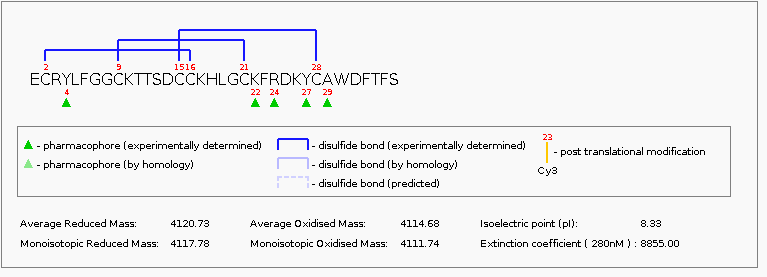
| Disulfide Bonds |
| Left Residue |
Right Residue |
Evidence |
| 2 |
16 |
Experimentally determined |
| 9 |
21 |
Experimentally determined |
| 15 |
28 |
Experimentally determined |
|
|
| Peptide Sequences |
>as:κ-theraphotoxin-Gr1a|sp:P56852 Toxin from venom of the spider Grammostola rosea that inhibits voltage-gated potassium and calcium channels
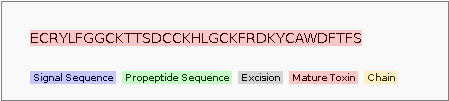
ECRYLFGGCKTTSDCCKHLGCKFRDKYCAWDFTFS |
Full BLAST |
BLAST mature toxin only
|
|
| Synonym |
Type |
| κ-theraphotoxin-Gr1a |
Recommended full name |
| κ-TRTX-Gr1a |
Recommended abbreviation |
| Hanatoxin-1 |
Synonym |
| HaTx1 |
Synonym (abbreviation) |
|
|
|