| |
| Toxin Name |
δ-theraphotoxin-Hm1a |
| Source Species |
Heteroscodra maculata (Togo starburst tarantula) |
| Toxin Group |
Theraphotoxin |
| Description |
δ-theraphotoxin-Hm1a is a gating modifier toxin that inhibits inactivation of the mammalian voltage-gated sodium channel Nav1.1. When tested against human Nav1.1–1.8 α subunits heterologously expressed in Xenopus oocytes, the toxin inhibited inactivation of Nav1.1 (EC50 = 38 ± 6 nM), with substantially weaker effects on Nav1.2 (EC50 = 236 nM) and Nav1.3 (EC50 = 220 nM), and no effect on Nav1.4–1.8 at concentrations up 1 μM. The toxin inhibits several subtypes of voltage-gated potassium channel with significantly lower potency than its effects on Nav1.1. It has little effect on Kv1.1-Kv1.6 and Kv3.4, but it is a moderately potent blocker of Kv2.1, Kv2.2, Kv4.1, Kv4.2, and Kv4.3. The toxin is a homolog of δ-theraphotoxin-Hm1b, which was isolated from the venom of the same species.
In mouse trigeminal neurons, the toxin enhances action potential firing and prolongs action potential duration without altering the resting membrane potential, consistent with inhibition of Nav1.1 inactivation. In an ex vivo skin-nerve preparation the toxin enhances firing of mechanosensitive Aδ fibres during mechanical stimulus. When injected into mouse hindpaw, the toxin elicits an immediate and robust nocifensive response. However, intraplantar injection of toxin does not cause neurogenic inflammation or alter sensitivity to heat, indicative of a modality-specific effect on mechanosensitive neurons.
Given that chronic mechanical hypersensitivity underlies the development of abdominal pain in patients with
irritable bowel syndrome, the toxin was tested in an ex vivo gut-nerve preparation. In healthy mice, the toxin evoked spiking in a subset of high-threshold mechanosensitive
colonic fibers that express functional Nav1.1 channels. In mice with chronic visceral mechanical hypersensitivity, which have an elevated baseline spiking frequency, the toxin increased spiking frequency even further, suggesting a role for Nav1.1 in visceral mechanical pain.
Similar to scorpion α-toxins that inhibit sodium channel inactivation, the toxin binds to the voltage sensor in channel domain IV. The binding affinity and subtype selectivity of the toxin is determined by residues within both the S1-S2 and S3-S4 loops of the domain IV voltage sensor. |
| Discovered |
2001 |
|
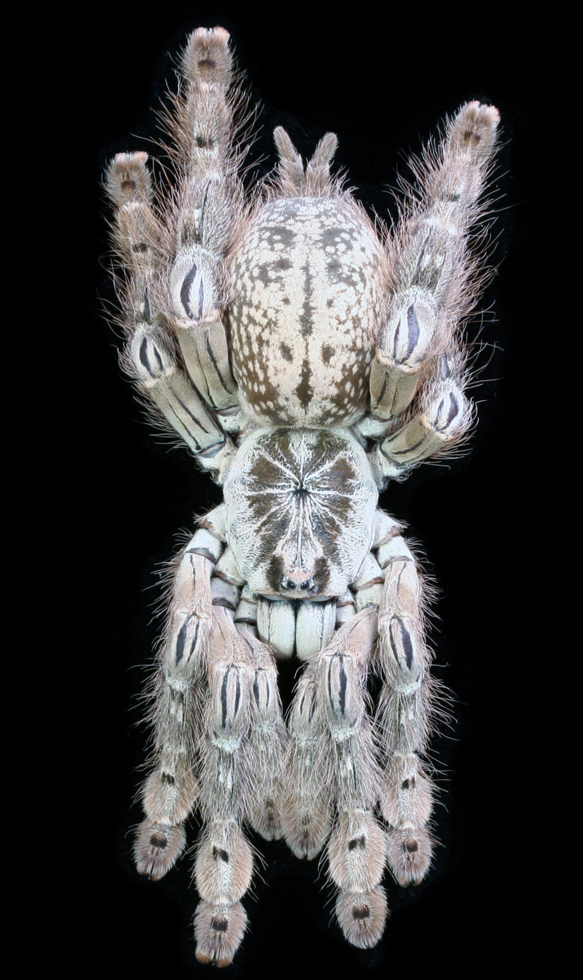
Sex: female, Prosoma length: 20mm
Photo courtesy of Bastian Rast
Use of photo governed by creative
commons noncommercial license
|
| This toxin last updated on Nov 01, 2016 |
|
| Current Taxonomy |
Historic Taxonomy |
| Kingdom |
Animalia |
| Phylum |
Arthropoda |
| Class |
Arachnida |
| Order |
Araneae |
| Infra-order |
Mygalomorphae |
| Family |
Theraphosidae |
| Genus |
Heteroscodra |
| Species |
maculata |
|
| Heteroscodra maculata |
| Heterscodra maculata |
|
|
| Molecular Target |
ED50 |
IC50 |
Kd |
Pharmacophore |
Comment |
| Potassium channel, voltage-gated (vertebrate): KV4.2 |
|
|
|
|
39% inhibition at 300 nM |
| Sodium channel, voltage-gated (vertebrate): NaV1.3 |
220.0
nM
|
|
|
|
Inhibits the inactivation of heterologously expressed Nav1.3 α subunits in Xenopus oocytes. |
| Potassium channel, voltage-gated (vertebrate): KV4.3 |
|
|
|
|
43% inhibition at 300 nM |
| Potassium channel, voltage-gated (vertebrate): KV2.1 (drk1) |
|
|
|
|
23% inhibition at 100 nM |
| Potassium channel, voltage-gated (vertebrate): KV2.2 |
|
300.0
nM
|
|
|
Inhibition of Kv2.2 expressed in oocytes by native toxin. Estimate based on observation that 300 nM toxin reduced currents by 51%, and 100 nM toxin reduced currents by 20%. |
| Sodium channel, voltage-gated (vertebrate): NaV1.1 |
38.0
|
|
|
|
Inhibits the inactivation of heterologously expressed Nav1.1 α subunits in Xenopus oocytes. |
| Potassium channel, voltage-gated (vertebrate): KV4.1 |
|
280.0
nM
|
|
|
Inhibition of Kv4.1 expressed in oocytes by native toxin |
| Sodium channel, voltage-gated (vertebrate): NaV1.2 |
236.0
nM
|
|
|
|
Inhibits the inactivation of heterologously expressed Nav1.2 α subunits in Xenopus oocytes. |
|
| Original Deposition References |
Escoubas P., Diochot S., Celerier M.-L., Nakajima T., Lazdunski M.
Mol. Pharmacol. 62:48-57(2002).
Novel tarantula toxins for subtypes of voltage-dependent potassium channels in the Kv2 and Kv4 subfamilies.
|
Osteen J.D., Herzig V., Gilchrist J., Emrick J.J., Zhang C., Wang X., Castro J., Garcia-Caraballo S., Grundy L., Rychkov G.Y., Dekan Z., Undheim E.A.B., Alewood P., Brierley S.M., Basbaum A.I., Bosmans F., King G.F., Julius D.
Nature 534: 494-499 (2016)
Subtype-selective spider toxins implicate Nav1.1 voltage-gated sodium channels in mechanical pain.
|
|
| Disulfide Bonds |
| Left Residue |
Right Residue |
Evidence |
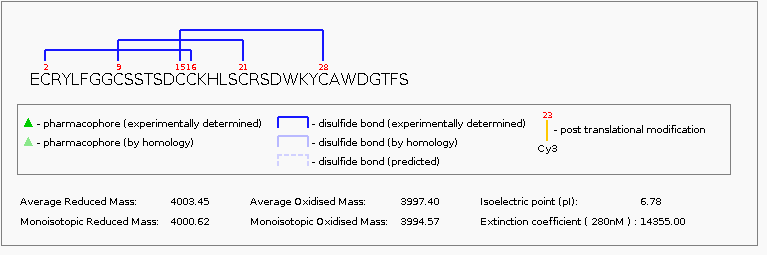
| 2 |
16 |
Experimentally determined |
| 9 |
21 |
Experimentally determined |
| 15 |
28 |
Experimentally determined |
|
|
| Peptide Sequences |
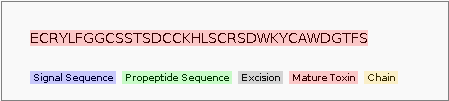
>as:δ-theraphotoxin-Hm1a|sp:P60992 Toxin from venom of the spider Heteroscodra maculata that inhibits inactivation of voltage-gated sodium channel Nav1.1
ECRYLFGGCSSTSDCCKHLSCRSDWKYCAWDGTFS |
Full BLAST |
BLAST mature toxin only
|
|
| Synonym |
Type |
| δ-theraphotoxin-Hm1a |
Recommended full name |
| δ-TRTX-Hm1a |
Recommended abbreviation |
| Heteroscodratoxin-1 |
Synonym |
| κ-theraphotoxin-Hm1a |
Synonym |
| HmTx1 |
Synonym (abbreviation) |
| κ-TRTX-Hm1a |
Synonym (abbreviation) |
|
|
|