|
|
 |
| |
| Toxin Name |
κ-theraphotoxin-Gr2c |
| Source Species |
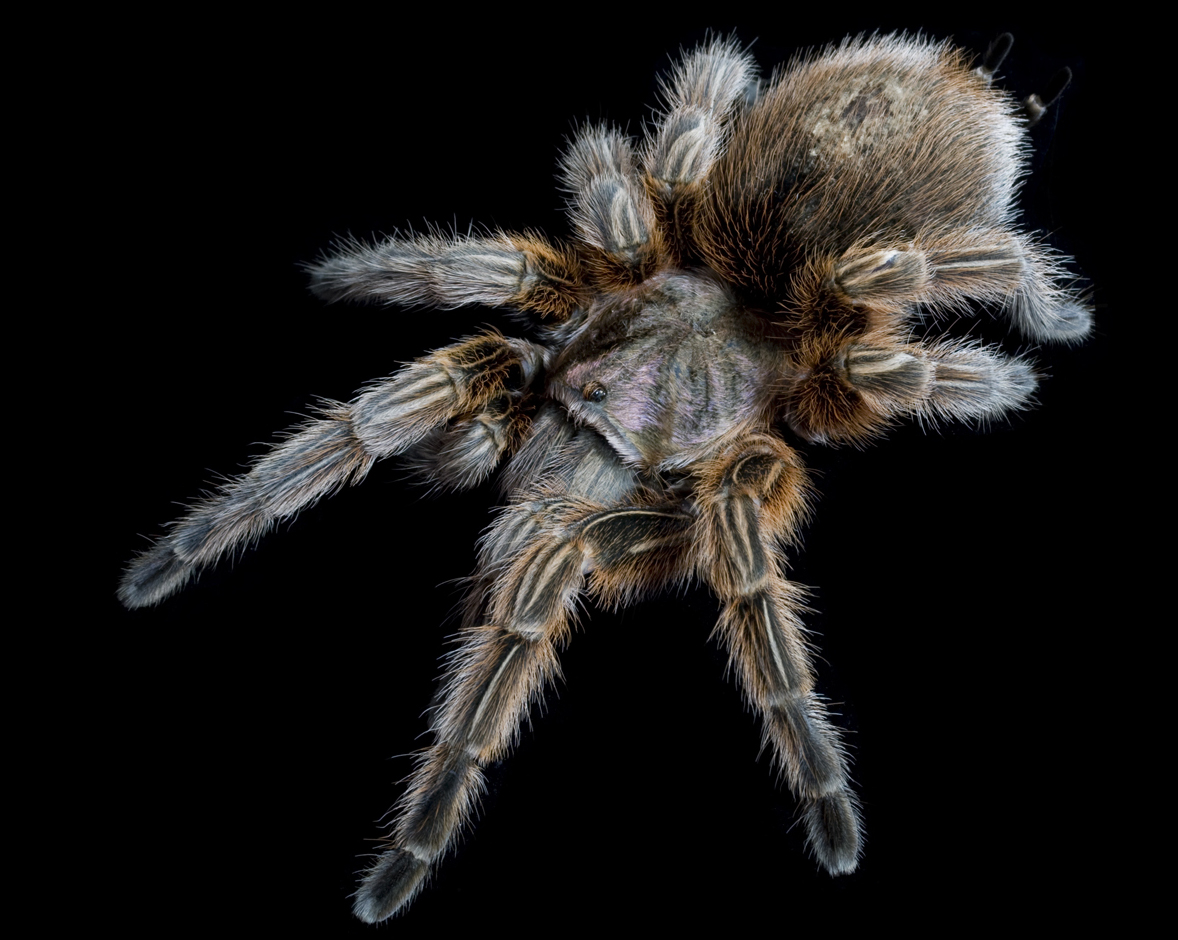
Grammostola rosea (Chilean rose tarantula) |
| Toxin Group |
Theraphotoxin |
| Description |
An unusual toxin that has been described in two separate patents for different applications. The first patent (U.S. Pat No. US5877026) describes the analgesic properties of κ-TRTX-Gr2c. When injected intrathecally into young rats, κ-TRTX-Gr2c showed analgesic effects in pain models such as the tail flick latency test, hot plate threshold test, von Frey threshold test, and formalin pain test.
The second patent (U.S. Patent No. 5968838) describes the ability of the toxin to block mechanosensitive ion channels (also called stretch-activated channels or SACs). The toxin blocks hypotonic cell swelling induced calcium release without blocking calcium channels, and has antiarrhthymic activity.
Finally, to further complicate the pharmacology of this toxin, it is a clearly a paralog of κ-theraphotoxin-Gr2b (the toxins differ by only two amino acid residues at the C-terminus), which inhibits the KvAP voltage-gated potassium channel from the archaebacterium Aeropyrum pernix by binding to the voltage sensor paddle. The diverse pharmacology of the toxin probably derives from an ability to partition into the lipid membrane. |
| Discovered |
1999 |
|
Sex: female, Prosoma length: 26mm
Photo courtesy of Bastian Rast
Use of photo governed by creative
commons noncommercial license
|
| This toxin last updated on Aug 22, 2014 |
|
| Current Taxonomy |
Historic Taxonomy |
| Kingdom |
Animalia |
| Phylum |
Arthropoda |
| Class |
Arachnida |
| Order |
Araneae |
| Infra-order |
Mygalomorphae |
| Family |
Theraphosidae |
| Genus |
Grammostola |
| Species |
rosea |
|
| Citharoscelus kochii |
| Citharoscelus spatulatus |
| Eurypelma rosea |
| Eurypelma spatulatum |
| Grammostola argentinense |
| Grammostola argentinensis |
| Grammostola cala |
| Grammostola rosea |
| Grammostola spathulata |
| Grammostola spatulata |
| Grammostola spatulatus |
| Lasiodora rosea |
| Mygale rosea |
| Mygale rubiginosa |
|
|
| Antiarrhythmic |
| Antinociceptive |
| Molecular Target |
ED50 |
IC50 |
Kd |
Pharmacophore |
Comment |
| Mechanosensitive ion channel: Eukaryotic mechanosensitive channel |
|
|
|
|
Inhibition of mechanosensitive channels by native toxin |
| Taxon |
ED50 |
LD50 |
PD50 |
Qualitative Information |
| Rattus norvegicus |
|
|
|
Intrathecally injected toxin showed analgesic effects in pain models such as the tail flick latency, hot plate threshold, von Frey threshold, and formalin pain test at nanomolar doses
|
|
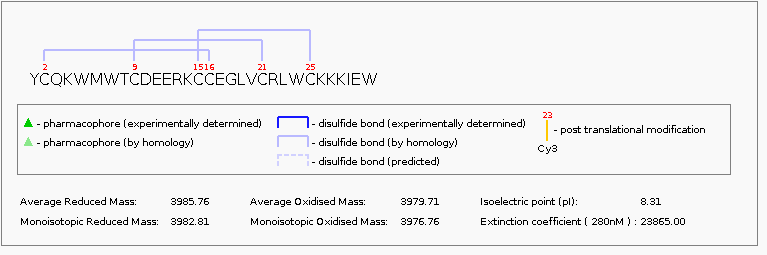
| Disulfide Bonds |
| Left Residue |
Right Residue |
Evidence |
| 2 |
16 |
By homology |
| 9 |
21 |
By homology |
| 15 |
25 |
By homology |
|
|
| Peptide Sequences |
>as:κ-theraphotoxin-Gr2c_1|sp:P61409 Toxin from venom of the spider Grammostola rosea that inhibits mechanosensitive channels
YCQKWMWTCDEERKCCEGLVCRLWCKKKIEW |
Full BLAST |
BLAST mature toxin only
|
>as:κ-theraphotoxin-Gr2c_2|sp:M5AYD2 Toxin from venom of the spider Grammostola rosea that inhibits mechanosensitive channels
MKAFFVILGLALLCAYSFALEEQDQLSLRNDLLTVMFAENSELTPETEERYCQKWMWTCD
EERKCCEGLVCRLWCKKKIEW |
Full BLAST |
BLAST mature toxin only
|
>as:κ-theraphotoxin-Gr2c_3|sp:M5AWU7 Toxin from venom of the spider Grammostola rosea that inhibits mechanosensitive channels
MKAFFVILGLALLCAYSFALEEQDQLSLRNDLLTVMFAENSELIPETEERYCQKWMWTCD
EERKCCEGLVCRLWCKKKIEW |
Full BLAST |
BLAST mature toxin only
|
|
| Synonym |
Type |
| κ-theraphotoxin-Gr2c |
Recommended full name |
| κ-TRTX-Gr2c |
Recommended abbreviation |
| Peptide GsAF II |
Synonym |
| Peptide GsAF II |
Synonym |
| Mechanotoxin-alpha |
Synonym |
| GTx2-1-2 |
Synonym (abbreviation) |
| GTx2-1-1 |
Synonym (abbreviation) |
|
|
|
|
|
 |
|
 |
|
|